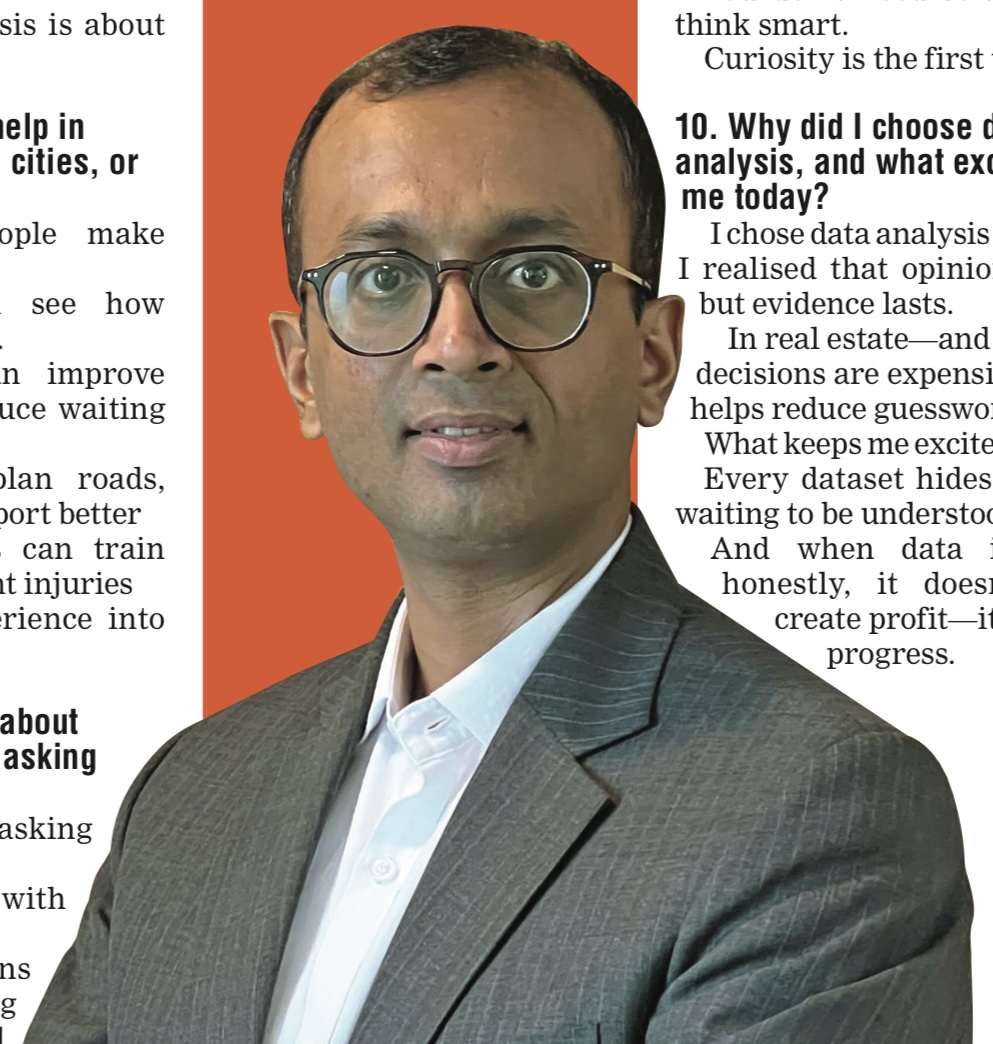

Data Analyst wizard Abhishek Gupta helps turn numbers into stories children can understand ABHISHEK GUPTA CEO and Co-Founder; CRE Matrix and IndexTap. He has 25 years of experience in Market Research, Business Analytics and Market Strategy Consulting 1. What is data analysis? (Explained to a child) Data analysis is like being a detective for …
Data Analyst wizard Abhishek Gupta helps turn numbers into stories children can understand
ABHISHEK GUPTA
CEO and Co-Founder; CRE Matrix and IndexTap. He has 25 years of experience in Market Research, Business Analytics and Market Strategy Consulting
1. What is data analysis? (Explained to a child)
Data analysis is like being a detective for numbers.
Imagine you have a big box of LEGO bricks. On their own, they’re just pieces. But when you look at them carefully, you can build something meaningful—a house, a car, or even a city.
Data analysis is about looking at numbers and figuring out what they’re trying to tell us, so we can make better decisions.
2. If numbers could talk, what stories would they tell?
Numbers talk about patterns, habits, and change.
They tell stories like:
“More people are choosing this over that.”
“This is growing faster than before.”
“Something unusual happened here.”
A good data analyst listens carefully—because numbers often whisper before they shout.
3. How is being a data analyst different from just making charts or counting things?
Counting tells you what happened.
Charts show you what it looks like.
Data analysis explains why it happened and what might happen next.
Charts are tools—but thinking is the real job.
4. Before looking at numbers, what questions does a data analyst ask?
Before touching data, I always ask:
What decision are we trying to make?
What problem are we trying to solve?
What would success look like?
If you don’t ask the right question, even perfect data can give the wrong answer.
5. Can data be confusing or misleading? How do we avoid that?
Yes—data can confuse or even mislead if used carelessly.
To avoid that, a data analyst:
-Checks where the data came from
-Looks at the full picture, not just one number
-Adds context, not just conclusions
Good data analysis is about truth, not drama.
6. How does data help in schools, hospitals, cities, or sports?
Data helps people make smarter choices:
-Schools can see how students learn best
-Hospitals can improve treatment and reduce waiting time
-Cities can plan roads, housing, and transport better
-Sports teams can train smarter and prevent injuries
Data turns experience into evidence.
7. Is data analysis about finding answers or asking questions?
It’s more about asking better questions.
Answers change with time.
Good questions keep improving decisions again and again.
8. With AI helping so much, what does a human data analyst still do?
AI can process numbers fast.
But humans:
-Decide what really matters
-Understand emotions, behaviour, and context
-Take responsibility for decisions
AI calculates.
Humans judge, interpret, and choose.
9. How can a child start thinking like a data analyst?
A child can:
– Ask “Why?” and “What changed?”
– Compare things (before vs after)
– Notice patterns in daily life—scores, weather, habits
You don’t need software to think smart.
Curiosity is the first tool.
10. Why did I choose data analysis, and what excites me today?
I chose data analysis because I realised that opinions fade, but evidence lasts.
In real estate—and in life—decisions are expensive. Data helps reduce guesswork.
What keeps me excited is this:
Every dataset hides a story waiting to be understood.
And when data is used honestly, it doesn’t just create profit—it creates progress.
Join the Club
Like this story? You’ll love our monthly newsletter.